Resumen
La alimentación es uno de los rubros más importantes en la producción porcina. Las fuentes de fósforo, proteína y energía representan los ingredientes más costosos del alimento. Las fitasas son enzimas que se han usado desde hace muchos años para aprovechar mejor el fósforo vegetal y reducir costos. Si bien se han generado muchas investigaciones, con distintas metodologías y resultados, su sistematización ha sido limitada. Por consiguiente, el objetivo de este trabajo fue evaluar el efecto de la inclusión de fitasas sobre el rendimiento productivo en porcinos. Se determinó tamaño de efecto, heterogeneidad, metaregresiones y sesgo de publicación. Los cerdos tratados con fitasas ganaron 25,17 g ( p < 0.05) más peso al día frente al control. Los lechones pueden ganar hasta 39,89 g ( p < 0.05). Los cerdos tratados con fitasas consumieron mayor cantidad de alimento 23,44 g y 28,61 g ( p < 0.05) más al día que el control en el análisis general y en lechones, respectivamente. La proteína cruda, la energía metabolizable, el calcio y fósforo total, la duración y el nivel de fitasas en la dieta afectan el rendimiento ( p < 0.05). No se encontró sesgo de publicación. En conclusión, la inclusión de fitasas favorece la ganancia de peso y el consumo de alimento en cerdos en general y en lechones, no así en cerdos en crecimiento-finalización. Se debe tener en cuenta el efecto de otros nutrientes al momento de la formulación, así como la duración y el nivel (dosis) de fitasas.
Introduction
The sustainability of animal production is based on the careful use of phosphorus (P). Phosphate, the extracted source of agricultural phosphorus, is a non-renewable resource. However, it is essential for animals’ growth, health, and well-being ( Misiura et al., 2020 ). P must be provided by efficient and sustainable means that minimize its waste. About 60 % of the phosphorus in an animal’s body is found in the bones in a fixed ratio with calcium (Ca), and the rest is found in the muscles ( Lautrou et al., 2021 ). P is essential for various biological processes in the pig, and nutritionists strive to meet the precise requirement for this mineral. The cell membrane is made of phospholipids; the phospholipid-based bilayer structure provides cell structural integrity and controls the flow of molecules in and out of the cell ( Berndt & Kumar, 2009 ). Adenosine-5’’-triphosphate is dubbed the molecular currency unit for intracellular energy transfer, which entails the enzyme-catalyzed transfer of the phosphoryl group ( Knowles, 1980 ). The P demand for a growing pig comprises maintenance and tissue deposition requirements ( Zhai et al., 2022 a).
Phosphorus is stored mainly as phytate in plant seeds, making it poorly available to monogastric animals such as pigs and birds. Because phytate is a polyanionic molecule, it has the ability to chelate positively charged cations, especially calcium, iron, and zinc ( Selle et al., 2009 ). In addition, it compromises the utilization of other dietary nutrients, such as protein, starch, and lipids. Reduced phosphorus utilization efficiency implies both higher levels of supplementation and a greater discharge of undigested nutrients to the environment (National Research Council, 2012).
The enzyme phytase catalyzes the gradual hydrolysis of phytate. Regarding animal nutrition, there are four possible sources of this enzyme available to animals: endogenous mucosal phytase, gut microbiota phytase, plant phytase, and exogenous microbial phytase. As endogenous mucosal phytase in monogastric organisms appears unable to hydrolyze sufficient amounts of phytate-bound P, supplementation with exogenous microbial phytase in diets is a standard method to increase the absorption of minerals and other nutrients ( Cowieson et al., 2017 ; Humer et al., 2015 ). Several research papers have tested phytases in pig diets to improve nutrient use and lower costs ( Dersjant-Li et al., 2019 ; Rosenfelder-Kuon et al., 2020 ). However, there is wide variability in the studies on genetics, duration and dose of supplementation, physiological stage, dietary levels of crude protein, metabolizable energy, calcium, and phosphorus, among others. This generates uncertainty in professionals dedicated to swine nutrition regarding phytases in diets.
Meta-analysis is a group of statistical tools that quantitatively synthesizes knowledge by analyzing the results of previously published scientific studies ( Sauvant et al., 2008 ). It makes it possible to obtain a measure of the combined effect with more precision than that of the individual studies, and, therefore, they have greater statistical power ( Catalá-López & Tobías, 2014 ). This research hypothesized that the dietary inclusion of phytases favors production performance in pigs despite the original studies’ variability of factors (moderators). This research aimed to determine the effect of the dietary inclusion of phytases on the production performance in pigs and the impact of various moderators (crude protein level, metabolizable energy, total calcium, total dietary phosphorus, days and level of phytase supplementation, and number of replicates per treatment) through a meta-analysis.
Materials and Methods
The meta-analysis consisted of searching for scientific articles in various electronic databases using keywords. Subsequently, those documents that met the inclusion criteria (mean, variability measure, number of repetitions, etc.) were selected. Finally, the effect size, heterogeneity, meta-regression, and publication bias tests were run. This study followed the methodology suggested by Palencia et al. (2016 ) and Rufino et al. (2019 ).
Source of information (data)
An electronic search of scientific articles was carried out in journals indexed to the following electronic databases: CAB Direct, Elsevier Biobase CABS, Google Scholar, Medline, PubMed, Science Direct (Journal), Scopus, Latindex, Scielo, Academic Search Complete, CAB Abstract, Directory of Open Access Journals, and Web of Science. For this purpose, a combination of keywords was used: phytases, diet, feed, nutrition, pigs, piglets, growth, finishing, production performance, and their equivalents in Spanish and Portuguese, without date restrictions, locating 157 articles.
Inclusion criteria
Experimental research articles in Spanish, English, and Portuguese were included, in which phytases were administered to healthy animals exclusively through the diet. The experiments had to have been conducted on piglets and pigs in the growing or finishing stage without considering race or country as exclusion factors. Also, they had to include at least two treatments (including the control group without phytase supplementation) containing the variables of interest (production performance) with their respective mean values, variability measures, and number of repetitions per treatment. Race was not considered an evaluation factor due to the high number of crossings (more than 35) reported in the included works. All the studies used were carried out under an intensive breeding system (information reported in the methodology of each research).
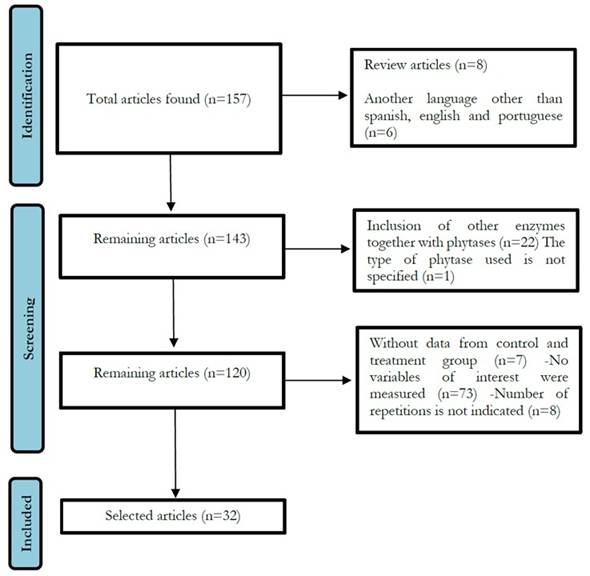
The data was obtained from 32 articles published between1993 and 2019 ( Adeola et al., 2006 ; Arredondo et al., 2019 ; Atakora et al., 2011 ; Bernal et al., 2006 ; Biehl & Baker, 1996 ; Blavi et al., 2019; Boling et al., 2000 ; Bournazel et al., 2018 ; Broomhead et al., 2019 ; Cromwell et al., 1993 , 1995; Dersjant-Li et al., 2017 ; Duffy et al., 2018 ; Gentile et al., 2003 ; Hill et al., 2009 ; Holloway et al., 2019 ; James et al., 2008 ; Jang et al., 2017 ; Jendza et al., 2005 ; Jolliff & Mahan, 2012 ; Kies et al., 2006 ; Murry et al., 1997 ; Nortey et al., 2007 ; Olukosi et al., 2007 ; Omogbenigun et al., 2003 ; Peter et al., 2001 ; Sands & Kay, 2007 ; She et al., 2017, 2018; Varley et al., 2010 , 2011; Woyengo et al., 2008 ), on which the respective analyses were performed, as shown in Figure 1 .
Figure 1 Flowchart for the selection of scientific articles based on PRISMA (2020) suggestions.
Statistical Analysis
The professional software MIX 2.0 Pro in Microsoft Excel ( Bax, 2016 ) was used for the statistical analysis of the data. The effect size of phytase supplementation was determined by the mean difference (MD) between the treatment and control groups, with 95 % confidence intervals. Heterogeneity was assessed using the inconsistency index (I 2 ) ( Cochran, 1954 ; Higgins & Thompson, 2002 ). In the cases where heterogeneity was found, meta-regressions were performed ( Borenstein et al., 2011 ). A random effects model was used according to the recommendations of Sauvant et al. (2008 ). The study effect should be considered random because when the database contains different individual studies, each study is a random outcome from a large population of studies, and the study effect represents the sum of the effects of many factors, all with minor effects on the dependent variable (Sauvant et al., 2008).
Relationships between variable Y and the primary explanatory variable X were studied using the quadratic model in Equation 1:
Y ij =µ + µ i + ß1 X ij + ß2 [X ij ] 2 + e ij (1)
Where Y ij is the dependent variable Y in experiment i with level j of phytase; X ij is the independent variable; µ is the overall intercept across all studies; µ i is the effect of experiment i on the intercept µ with the condition that Σµ i = 0; ß1 and ß2 are respectively the linear and quadratic coefficients of the relationship, and e ij is the residual error.
Based on the available data, the production performance variables analyzed were average daily weight gain (ADG), average daily feed intake (ADFI), and feed efficiency (FE). For each variable, three meta-analyses (MAs) were carried out: a general MA (without considering the production stage) and another considering the production stage, divided into two categories: piglets and growing-finishing pigs, totaling 12 MAs.
Results and Discussion
Table 1 shows the mean value and standard deviation of the evaluated production variables: ADG, ADFI, and FE.
Table 1 Summary of production variables Response variable Meta-analysis Summarized response variable Treatment Control Mean SD Mean SD ADG (g/day) General pigs 576.76 210.64 552.74 219.75 Piglets 487.60 143.54 463.07 149.17 Growing-finishing pigs 875.68 84.10 853.38 133.30 ADFI (g/day) General pigs 1,143.69 770.31 1,111.95 772.13 Piglets 771.69 276.88 735.93 261.96 Growing-finishing pigs 2,303.47 649.78 2,284.24 647.71 FE (kg/kg) General pigs 0.59 0.17 0.59 0.15 Piglets 0.62 0.15 0.63 0.11 Growing-finishing pigs 0.35 0.07 0.34 0.08 ADG: average daily gain; ADFI: average daily feed intake; FE: feed efficiency; SD : standard deviation Source: Prepared by the authors.
For all the categories analyzed, the variables ADG and ADFI are higher in those animals that received phytases ( Table 1 ). Regarding feed efficiency, it was found to be higher in the control group in the general analysis (0.59 vs. 0.59 kg/kg) and in piglets (0.63 vs. 0.62 kg/kg). Feed efficiency was higher in the growing-finishing stage in those pigs supplemented with phytases (0.35 vs. 0.34 kg/kg); no significant difference was found. Table 2 shows the size of the effect of the dietary inclusion of phytases on ADG, ADFI, and FE in pigs. The general analysis reveals that the supplemented pigs gained 25.17 g ( p < 0.05) more weight per day than those that did not receive phytases ( Table 2 ). A similar trend occurs in the case of piglets, which gained between 13.22 and 39.89 g ( p < 0.05) more per day versus those not supplemented. In the case of pigs in the growing-finishing stage, although no significant difference was found ( p = 0.16), ADG is higher in pigs that ingest phytases 875.68 vs. 853.37 g/day than those unsupplemented. This shows that phytases increase the availability of phosphorus for the pig ( Arredondo et al., 2019 ). With this, there is a greater amount of this mineral for the different metabolic processes (ATP generation) with which the animal can deposit more tissue ( Rosenfelder-Kuon et al., 2020 ). By including fewer sources of phosphorus in the diet, production costs decrease ( Dersjant-Li et al., 2019 ). Additionally, there is less phosphorus excretion into the environment ( Hill et al., 2009 ).
The pigs that received phytases ingested more feed, 23.44 and 28.61 g more per day, compared to the control group in the general analysis and in piglets, respectively ( Table 2 ).
Table 2 Effect size of dietary inclusion of phytases on pigs’ ADG, ADFI, and FE Response variable Meta-analysis Effect size MD CI p ADG (g/day) General pigs 25.17 12.01 38.33 0.00 Piglets 26.56 13.23 39.89 0.00 Growing-finishing pigs 22.47 -8.60 53.54 0.16 ADFI (g/day) General pigs 23.45 11.02 35.87 0.00 Piglets 28.61 14.06 43.17 0.00 Growing-finishing pigs -1.24 -18.90 16.43 0.89 FE (kg/kg) General pigs 0.00 -0.01 0.01 0.99 Piglets -0.00 -0.02 0.02 0.77 Growing-finishing pigs 0.01 -0.01 0.02 0.27 ADG: average daily gain; ADFI: average daily feed intake; FE: feed efficiency; MD : mean difference; CI : confidence interval; p : probability value Source: Prepared by the authors.
Table 3 shows the results of the inconsistency index for each production variable. As mentioned by Higgins and Thompson (2002 ), this study found high heterogeneity (>75 %) in all ADG and FE categories. However, the ADFI presented moderate heterogeneity (<50 %) for general pigs and piglets. There was a low heterogeneity of 24.96 % in the category of growing-finishing pigs.
Table 3 Index of inconsistency of the dietary inclusion of phytases on ADG, ADFI, and FE in pigs Variable Meta-analysis I 2 (%) ADG General pigs 87.33 Piglets 81.34 Growing-finishing pigs 93.05 ADFI General pigs 65.25 Piglets 68.42 Growing-finishing pigs 24.96 FE General pigs 93.64 Piglets 93.45 Growing-finishing pigs 89.81 ADG: average daily gain; ADFI: average daily feed intake; FE: feed efficiency Source: Prepared by the authors.
Tables 4 to 10 present the results of the meta-regressions. Crude protein level, metabolizable energy, total calcium, total dietary phosphorus, days and level of phytase supplementation, and number of replicates per treatment were used as moderator variables in this study. For each percentage unit that crude protein in the diet increases, the ADG of all production categories decreases ( p < 0.01) by 5.05 g/day (general pigs), 8.09 g/day (piglets), and 11.98 g/day (growing-finishing pigs) ( Table 4 ). A similar trend occurs for the feed efficiency variable; in all stages, the increase in CP makes the pig less efficient ( p < 0.01): general pigs (0.16), piglets (0.20), and growing-finishing pigs (0.12). The effect of CP on these production variables could be because the level of CP in the diet is higher than required, which generates a waste of energy in the pig to metabolize and eliminate excess nitrogen in the form of urea ( Jha & Berrocoso, 2016 ). Part of this is because many published articles are not recent and did not formulate diets using the ideal protein and synthetic amino acids ( van Milgen & Dourmad, 2015 ).
Table 4 Meta-regression for crude protein level in diets Variable Meta-analysis Meta-regression: crude protein Intercept (a) CP (b) Estimated p Estimated p ADG General pigs 129.46 <0.01 -5.05 <0.01 Piglets 210.89 <0.01 -8.10 <0.01 Growing-finishing pigs 233.63 <0.01 -11.99 <0.01 ADFI General pigs -12.93 0.49 1.47 0.10 Piglets 120.23 0.00 -4.32 0.02 Growing-finishing pigs -3.42 0.93 0.08 0.97 FE General pigs 0.16 <0.01 -0.01 <0.01 Piglets 0.20 <0.01 -0.01 <0.01 Growing-finishing pigs 0.12 <0.01 -0.01 <0.01 CP: Crude Protein; ADG: average daily gain; ADFI: average daily feed intake; FE: feed efficiency; p : probability value Source: Prepared by the authors.
Regarding the level of metabolizable energy (ME) of diets for each kilocalorie that increases in the diet, the evaluated variables decrease ADG (<0.01) and FE (<0.01; Table 5 ). The higher the energy density in the diet, the less the feed consumption by satiating the pig’s appetite more quickly ( Li & Patience, 2017 ), even more so when phytases are included in the diet since these increase the digestibility of nutrients and, therefore, satiety ( Arredondo et al., 2019 ).
For each percentage unit (%) that increases in total Ca and P in diets ( Tables 6 and 7), the production performance of the pig, average daily gain in piglets and growing-finishing pigs (<0.01), and FE (<0.01) in all the production categories analyzed decrease. This tendency was not found in ADFI (Ca) in the growing-finishing pigs ( p = 0.98) nor in FE in piglets (P) ( p = 0.02), where the values were positive. The tendency to reduce production performance is probably due to excess macrominerals in diets, which generate competition between them at the intestinal level, limiting the absorption of other minerals through the enterocyte ( Gerlinger et al., 2021 ). Setting the same total Ca/total P ratio in diets supplemented with increasing doses of phytases creates an imbalance of digestible Ca and P, which could harm bone mineralization and, therefore, compromise the efficacy of phytases in relationship with P and the production performance of the animal ( Zhai et al., 2022 b). In addition, there is evidence that high levels of minerals in the diet reduce feed intake, and therefore, ADG and FE will be affected. An important factor to consider is that the phytase use arrays may not be correctly calculated, underestimating the release of Ca and P from dietary ingredients ( Bedford & Cowieson, 2020 ; Dersjant-Li et al., 2019 ; Lautrou et al., 2020 ). Additionally, the significant variability in the level of nutrients between the different raw materials used in the formulation of swine diets must be considered (National Research Council, 2012; Rostagno et al., 2017 ).
Table 5 Meta-regression for metabolizable energy levels of diets Variable Meta-analysis Meta-regression: metabolizable energy Intercept (a) ME (b) Estimated p Estimated p ADG General pigs 55.62 0.25 -0.01 0.52 Piglets 233.84 <0.01 -0.06 <0.01 Growing-finishing pigs -1,113.21 <0.01 0.34 <0.01 ADFI General pigs 239.54 0.00 -0.02 0.01 Piglets 469.08 <0.01 -0.13 <0.01 Growing-finishing pigs 481.41 0.02 -0.15 0.02 FE General pigs 0.18 <0.01 -0.00 <0.01 Piglets 0.32 <0.01 -0.00 <0.01 Growing-finishing pigs -2.04 <0.01 0.00 <0.01 ME: metabolizable energy; ADG: average daily gain; ADFI: average daily feed intake; FE: feed efficiency; p : probability value Source: Prepared by the authors.
Table 6 Meta-regression for total Ca level of diets Variable Meta-analysis Meta-regression: total calcium Intercept (a) Ca (b) Estimated p Estimated p ADG General pigs 113.25 <0.01 -13.35 <0.01 Piglets 95.56 <0.01 -9.56 <0.01 Growing-finishing pigs 161.48 <0.01 -21.69 <0.01 ADFI General pigs 106.10 <0.01 -13.78 <0.01 Piglets 123.87 <0.01 -15.48 <0.01 Growing-finishing pigs -3.28 0.94 1.81 0.98 FE General pigs 0.05 <0.01 -0.07 <0.01 Piglets 0.03 <0.01 -0.03 0.03 Growing-finishing pigs 0.07 <0.01 -0.10 <0.01 Ca: total calcium; ADG: average daily gain; ADFI: average daily feed intake; FE: feed efficiency; p : probability value Source: Prepared by the authors.
Table 7 Meta-regression for total P level of diets Variable Meta-analysis Meta-regression: total phosphorus Intercept (a) P (b) Estimated p Estimated p ADG General pigs 85.48 <0.01 -11.03 <0.01 Piglets 55.41 <0.01 -4.05 <0.01 Growing-finishing pigs 187.91 <0.01 -28.61 <0.01 ADFI General pigs 39.91 <0.01 -4.27 <0.01 Piglets 49.47 <0.01 -4.79 <0.01 Growing-finishing pigs 10.92 0.68 -2.61 0.61 FE General pigs 0.04 <0.01 -0.06 <0.01 Piglets 0.00 0.84 0.03 0.02 Growing-finishing pigs 0.09 <0.01 -0.12 <0.01 P: total phosphorus; ADG: average daily gain; ADFI: average daily feed intake; FE: feed efficiency; p : probability value Source: Prepared by the authors.
For each day that phytases are supplemented in diets, the ADG increases by 2.31 g/day ( p < 0.01) in the general analysis and by 2.38 g/day ( p < 0.01) in piglets and growing-finishing pigs ( Table 8 ). ADFI also increases for each day of phytase supplementation by 1.93 g/day in general pigs ( p < 0.01), 2.09 g/day in piglets ( p < 0.01), and 0.93 g/day in the growing-finishing pigs ( p = 0.29). In all production categories, feed efficiency is improved between 1.1 and 1.4 g ( p < 0.01) for each day that phytase supplementation increases. This effect is related to the fact that phytases increase the digestibility of the ingredients in the diet, providing the animal with a greater amount of nutrients for the deposition of body tissue ( Zouaoui et al., 2018 ).
Regarding the level of phytase supplementation ( Table 9 ), for each unit of phytase increment ADG in general pigs (5 g/day, p < 0.01) and piglets (7 g/day, p < 0.01) but not in growing-finishing pigs. In growing-finishing pigs, the ADG decreased by 39 g/day ( p < 0.01). ADFI increases as the level of phytases increases by 9 g/day ( p < 0.01) in general pigs and 8 g/day ( p < 0.01) in piglets. However, it is reduced by 7 g/day ( p = 0.57) in growing-finishing pigs. The feed efficiency is less affected by the increase in the level of phytases in all the categories analyzed. The preceding would be contradictory since studies show that an increase in the level of phytases in the diet increases nitrogen retention and the concentration of metabolizable energy ( Arredondo et al., 2019 ).
Table 8 Meta-regression for days of supplementation Variable Meta-analysis Meta-regression: days of phytase supplementation Intercept (a) Days of supplementation (b) Estimated p Estimated p ADG General pigs -37.83 <0.01 2.31 <0.01 Piglets -27.70 <0.01 2.38 <0.01 Growing-finishing pigs -63.25 <0.01 2.39 <0.01 ADFI General pigs -25.87 <0.01 1.93 <0.01 Piglets -22.80 0.00 2.10 <0.01 Growing-finishing pigs -23.58 0.27 0.93 0.29 FE General pigs -0.03 <0.01 0.00 <0.01 Piglets -0.03 <0.01 0.00 <0.01 Growing-finishing pigs -0.03 <0.01 0.00 <0.01 ADG: average daily gain; ADFI: average daily feed intake; FE: feed efficiency; p: probability value Source: Prepared by the authors.
Table 9 Meta-regression for the level of phytase supplementation Variable Meta-analysis Meta-regression: supplementation level (dose) Intercept (a) Supplementation level (b) Estimated p Estimated p ADG General pigs 16.41 <0.01 0.01 <0.01 Piglets 24.73 <0.01 0.01 <0.01 Growing-finishing pigs 45.96 <0.01 -0.04 <0.01 ADFI General pigs 5.65 0.14 0.01 <0.01 Piglets 11.07 0.01 0.01 <0.01 Growing-finishing pigs 2.88 0.79 -0.01 0.57 FE General pigs -0.01 <0.01 0.00 <0.01 Piglets 0.01 <0.01 0.00 <0.01 Growing-finishing pigs -0.00 0.89 -0.00 0.01 ADG: average daily gain; ADFI: average daily feed intake; FE: feed efficiency; p : probability value Source: Prepared by the authors.
Table 10 Meta-regression for number of repetitions per treatment Variable Meta-analysis Meta-regression: replicates per treatment Intercept (a) Replicates (b) Estimated p Estimated p ADG General pigs 61.72 <0.01 -4.51 <0.01 Piglets 26.68 0.09 0.92 0.62 Growing-finishing pigs 98.93 <0.01 -11.70 <0.01 ADFI General pigs 2.08 0.90 1.92 0.35 Piglets 58.40 0.02 -4.03 0.17 Growing-finishing pigs -6.85 0.81 0.71 0.86 FE General pigs 0.10 <0.01 -0.01 <0.01 Piglets 0.09 <0.01 -0.01 <0.01 Growing-finishing pigs 0.06 <0.01 -0.01 <0.01 ADG: average daily gain; ADFI: average daily feed intake; FE: feed efficiency; p : probability value Source: Prepared by the authors.
Regarding the number of repetitions per treatment ( Table 10 ), it can be seen that for each repetition that increases, feed efficiency decreases by 11.18 g ( p < 0.01) in general pigs, 9.12 ( p < 0.01) in piglets, and 7.26 g ( p < 0.01) in growing-finishing pigs. It is important to consider this when designing an experiment and determining the number of replicates per treatment. Few repetitions do not allow for the detection of significant effects in research ( Aron & Hays, 2004 ). Table 11 shows the results of publication biases evaluated using Egger’s test. We found no publication bias in any of the evaluated variables; that is, research papers are published showing an effect in favor of phytases on production performance or no effect.
Table 11 Publication biases of the dietary inclusion of phytases on ADG, ADFI, and FE in pigs Variable Meta-analysis p ADG General pigs 0.33 ADFI General pigs 0.49 FE General pigs 0.43 ADG: average daily gain; ADFI: average daily feed intake; FE: feed efficiency; p : probability value. Source: Prepared by the authors.
| ADG (g/day) | General pigs | 576.76 | 210.64 | 552.74 | 219.75 |
| Piglets | 487.60 | 143.54 | 463.07 | 149.17 | |
| Growing-finishing pigs | 875.68 | 84.10 | 853.38 | 133.30 | |
| ADFI (g/day) | General pigs | 1,143.69 | 770.31 | 1,111.95 | 772.13 |
| Piglets | 771.69 | 276.88 | 735.93 | 261.96 | |
| Growing-finishing pigs | 2,303.47 | 649.78 | 2,284.24 | 647.71 | |
| FE (kg/kg) | General pigs | 0.59 | 0.17 | 0.59 | 0.15 |
| Piglets | 0.62 | 0.15 | 0.63 | 0.11 | |
| Growing-finishing pigs | 0.35 | 0.07 | 0.34 | 0.08 |
| ADG (g/day) | General pigs | 25.17 | 12.01 | 38.33 | 0.00 |
| Piglets | 26.56 | 13.23 | 39.89 | 0.00 | |
| Growing-finishing pigs | 22.47 | -8.60 | 53.54 | 0.16 | |
| ADFI (g/day) | General pigs | 23.45 | 11.02 | 35.87 | 0.00 |
| Piglets | 28.61 | 14.06 | 43.17 | 0.00 | |
| Growing-finishing pigs | -1.24 | -18.90 | 16.43 | 0.89 | |
| FE (kg/kg) | General pigs | 0.00 | -0.01 | 0.01 | 0.99 |
| Piglets | -0.00 | -0.02 | 0.02 | 0.77 | |
| Growing-finishing pigs | 0.01 | -0.01 | 0.02 | 0.27 |
| ADG | General pigs | 87.33 |
| Piglets | 81.34 | |
| Growing-finishing pigs | 93.05 | |
| ADFI | General pigs | 65.25 |
| Piglets | 68.42 | |
| Growing-finishing pigs | 24.96 | |
| FE | General pigs | 93.64 |
| Piglets | 93.45 | |
| Growing-finishing pigs | 89.81 |
| ADG | General pigs | 129.46 | <0.01 | -5.05 | <0.01 |
| Piglets | 210.89 | <0.01 | -8.10 | <0.01 | |
| Growing-finishing pigs | 233.63 | <0.01 | -11.99 | <0.01 | |
| ADFI | General pigs | -12.93 | 0.49 | 1.47 | 0.10 |
| Piglets | 120.23 | 0.00 | -4.32 | 0.02 | |
| Growing-finishing pigs | -3.42 | 0.93 | 0.08 | 0.97 | |
| FE | General pigs | 0.16 | <0.01 | -0.01 | <0.01 |
| Piglets | 0.20 | <0.01 | -0.01 | <0.01 | |
| Growing-finishing pigs | 0.12 | <0.01 | -0.01 | <0.01 |
| ADG | General pigs | 55.62 | 0.25 | -0.01 | 0.52 |
| Piglets | 233.84 | <0.01 | -0.06 | <0.01 | |
| Growing-finishing pigs | -1,113.21 | <0.01 | 0.34 | <0.01 | |
| ADFI | General pigs | 239.54 | 0.00 | -0.02 | 0.01 |
| Piglets | 469.08 | <0.01 | -0.13 | <0.01 | |
| Growing-finishing pigs | 481.41 | 0.02 | -0.15 | 0.02 | |
| FE | General pigs | 0.18 | <0.01 | -0.00 | <0.01 |
| Piglets | 0.32 | <0.01 | -0.00 | <0.01 | |
| Growing-finishing pigs | -2.04 | <0.01 | 0.00 | <0.01 |
| ADG | General pigs | 113.25 | <0.01 | -13.35 | <0.01 |
| Piglets | 95.56 | <0.01 | -9.56 | <0.01 | |
| Growing-finishing pigs | 161.48 | <0.01 | -21.69 | <0.01 | |
| ADFI | General pigs | 106.10 | <0.01 | -13.78 | <0.01 |
| Piglets | 123.87 | <0.01 | -15.48 | <0.01 | |
| Growing-finishing pigs | -3.28 | 0.94 | 1.81 | 0.98 | |
| FE | General pigs | 0.05 | <0.01 | -0.07 | <0.01 |
| Piglets | 0.03 | <0.01 | -0.03 | 0.03 | |
| Growing-finishing pigs | 0.07 | <0.01 | -0.10 | <0.01 |
| ADG | General pigs | 85.48 | <0.01 | -11.03 | <0.01 |
| Piglets | 55.41 | <0.01 | -4.05 | <0.01 | |
| Growing-finishing pigs | 187.91 | <0.01 | -28.61 | <0.01 | |
| ADFI | General pigs | 39.91 | <0.01 | -4.27 | <0.01 |
| Piglets | 49.47 | <0.01 | -4.79 | <0.01 | |
| Growing-finishing pigs | 10.92 | 0.68 | -2.61 | 0.61 | |
| FE | General pigs | 0.04 | <0.01 | -0.06 | <0.01 |
| Piglets | 0.00 | 0.84 | 0.03 | 0.02 | |
| Growing-finishing pigs | 0.09 | <0.01 | -0.12 | <0.01 |
| ADG | General pigs | -37.83 | <0.01 | 2.31 | <0.01 |
| Piglets | -27.70 | <0.01 | 2.38 | <0.01 | |
| Growing-finishing pigs | -63.25 | <0.01 | 2.39 | <0.01 | |
| ADFI | General pigs | -25.87 | <0.01 | 1.93 | <0.01 |
| Piglets | -22.80 | 0.00 | 2.10 | <0.01 | |
| Growing-finishing pigs | -23.58 | 0.27 | 0.93 | 0.29 | |
| FE | General pigs | -0.03 | <0.01 | 0.00 | <0.01 |
| Piglets | -0.03 | <0.01 | 0.00 | <0.01 | |
| Growing-finishing pigs | -0.03 | <0.01 | 0.00 | <0.01 |
| ADG | General pigs | 16.41 | <0.01 | 0.01 | <0.01 |
| Piglets | 24.73 | <0.01 | 0.01 | <0.01 | |
| Growing-finishing pigs | 45.96 | <0.01 | -0.04 | <0.01 | |
| ADFI | General pigs | 5.65 | 0.14 | 0.01 | <0.01 |
| Piglets | 11.07 | 0.01 | 0.01 | <0.01 | |
| Growing-finishing pigs | 2.88 | 0.79 | -0.01 | 0.57 | |
| FE | General pigs | -0.01 | <0.01 | 0.00 | <0.01 |
| Piglets | 0.01 | <0.01 | 0.00 | <0.01 | |
| Growing-finishing pigs | -0.00 | 0.89 | -0.00 | 0.01 |
| ADG | General pigs | 61.72 | <0.01 | -4.51 | <0.01 |
| Piglets | 26.68 | 0.09 | 0.92 | 0.62 | |
| Growing-finishing pigs | 98.93 | <0.01 | -11.70 | <0.01 | |
| ADFI | General pigs | 2.08 | 0.90 | 1.92 | 0.35 |
| Piglets | 58.40 | 0.02 | -4.03 | 0.17 | |
| Growing-finishing pigs | -6.85 | 0.81 | 0.71 | 0.86 | |
| FE | General pigs | 0.10 | <0.01 | -0.01 | <0.01 |
| Piglets | 0.09 | <0.01 | -0.01 | <0.01 | |
| Growing-finishing pigs | 0.06 | <0.01 | -0.01 | <0.01 |
| ADG | General pigs | 0.33 |
| ADFI | General pigs | 0.49 |
| FE | General pigs | 0.43 |
Conclusion
In this study, the various macro ingredients of the diet were not considered for the effect of phytases on the production performance of pigs. It is important to remember that phytic phosphorus is found in ingredients of plant origin, so phytases would affect other nutrients’ digestibility.
It is necessary to develop more experiments in which the effect of phytases is considered in different breeds (crossings), particle sizes, and forms of food. We should seek to be more precise in estimating the enzyme’s effect and generate benefits for the pork producer and the environment.
The dietary inclusion of phytases favors daily weight gain and average daily feed intake in general pigs and piglets but not in growing-finishing pigs. The effect of other nutrients in the diet, such as crude protein, metabolizable energy, Ca, and P, and the duration and level (dose) of phytases depending on the production variable you want to improve must be taken into account at the time of formulation.
Referencias
- Adeola, O., Olukosi, O. A., Jendza, J. A., Dilger, R. N., & Bedford, M. R. (2006). Response of growing pigs to
Peniophora lycii - andEscherichia coli -derived phytases or varying ratios of calcium to total phosphorus.Animal Science ,82 (5), 637-644. https://doi.org/10.1079/ASC200676 - Aron, D., & Hays, V. (2004). How many pigs? Statistical power considerations in swine nutrition experiments.
Journal of Animal Science ,82 (13), 245-254. - Arredondo, M. A., Casas, G. A., & Stein, H. H. (2019). Increasing levels of microbial phytase increases the digestibility of energy and minerals in diets fed to pigs.
Animal Feed Science and Technology ,248 , 27-36. https://doi.org/10.1016/j.anifeedsci.2019.01.001 - Atakora, J. K., Moehn, S., Sands, J. S., & Ball, R. O. (2011). Effects of dietary crude protein and phytase-xylanase supplementation of wheat grain based diets on energy metabolism and enteric methane in growing finishing pigs.
Animal Feed Science and Technology , (166), 422-429. https://doi.org/10.1016/j.anifeedsci.2011.04.030 - Bax, L. (2016).
MIX 2.0 - Professional software for meta-analysis in Excel . Version 2.0.1.5 . BiostatXL. - Bedford, M. R., & Cowieson , A. J. (2020). Matrix values for exogenous enzymes and their application in the real world.
Journal of Applied Poultry Research ,29 (1), 15-22. https://doi.org/10.1016/j.japr.2019.10.011 - Bernal, H., Colin, J., Morales, H., Meza, Z., Gutiérrez, E., Ruiz, E. A., & Valdivié, M. (2006). Sustitución de fosfato monocálcico por la enzima fitasa en dietas para cerdos de ceba.
Revista Cubana de Ciencia Agrícola ,40 (2), 193-200. https://www.redalyc.org/pdf/1930/193017714009.pdf - Berndt, T., & Kumar, R. (2009). Novel mechanisms in the regulation of phosphorus homeostasis.
Physiology ,24 (1), 17-25. https://doi.org/10.1152/physiol.00034.2008 - Biehl, R. R., & Baker, D. H. (1996). Efficacy of supplemental 1 α-hydroxycholecalciferol and microbial phytase for young pigs fed phosphorus-or amino acid-deficient corn-soybean meal diets.
Journal of Animal Science ,74 (12), 2960-2966. https://doi.org/10.2527/1996.74122960x - Blavi, L., Muñoz, C. J., Broomhead, J. N., & Stein, H. H. (2019). Effects of a novel corn-expressed
E. coli phytase on digestibility of calcium and phosphorous, growth performance, and bone ash in young growing pigs.Journal of Animal Science ,97 (8), 3390-3398. https://doi.org/10.1093/jas/skz190 - Boling, S. D., Webel, D. M., Mayromichalis, I., Parsons, C. M., & Baker, D. H. (2000). The effects of citric acid on phytate-phosphorus utilization in young chicks and pigs.
Journal of Animal Science ,78 (3), 682-689. https://doi.org/10.2527/2000.783682x - Borenstein, M., Hedges, L. V., Higgins, J. P., & Rothstein, H. R. (2011).
Introduction to meta-analysis . John Wiley & Sons. - Bournazel, M., Lessire, M., Duclos, M. J., Magnin, M., Meme, N., Peyronnet, C., & Narcy, A. (2018). Effects of rapeseed meal fiber content on phosphorus and calcium digestibility in growing pigs fed diets without or with microbial phytase.
Animal ,12 (1), 34-42. https://doi.org/10.1017/S1751731117001343 - Broomhead, J. N., Lessard, P. A., Raab, R. M., & Lanahan, M. B. (2019). Effects of feeding corn-expressed phytase on the live performance, bone characteristics, and phosphorus digestibility of nursery pigs.
Journal of Animal Science ,97 (3), 1254-1261. https://doi.org/10.1093/jas/sky479 - Catalá-López, F., & Tobías, A. (2014). Metaanálisis en ensayos clínicos aleatorizados, heterogeneidad e intervalos de predicción.
Medicina Clínica ,142 (6), 270-274. https://doi.org/10.1016/j.medcli.2013.06.013 - Cochran, W. G. (1954). The combination of estimates from different experiments.
Biometrics ,10 (1), 101-129. https://doi.org/10.2307/3001666 - Cowieson, A. J., Ruckebusch, J. P., Sorbara, J. O., Wilson, J. W., Guggenbuhl, P., Tanadini, L., & Roos, F. F. (2017). A systematic view on the effect of microbial phytase on ileal amino acid digestibility in pigs.
Animal Feed Science and Technology ,231 , 138-149. https://doi.org/10.1016/j.anifeedsci.2017.07.007 - Cromwell, G. L., Coffey, R. D., Parker, G. R., Monegue, H. J., & Randolph, J. H. (1995). Efficacy of a recombinant-derived phytase in improving the bioavailability of phosphorus in corn-soybean meal diets for pigs.
Journal of Animal Science ,73 (7), 2000-2008. https://doi.org/10.2527/1995.7372000x - Cromwell, G. L., Stahly, T. S., Coffey, R. D., Monegue, H. J., & Randolph, J. H. (1993). Efficacy of phytase in improving the bioavailability of phosphorus in soybean meal and corn-soybean meal diets for pigs.
Journal of Animal Science ,71 (7), 1831-1840. https://doi.org/10.2527/1993.7171831x - Dersjant-Li, Y., Hruby, M., Evans, C., & Greiner, R. (2019). A critical review of methods used to determine phosphorus and digestible amino acid matrices when using phytase in poultry and pig diets.
Journal of Applied Animal Nutrition , 7(e2), 1-9. https://doi.org/10.1017/JAN.2019.1 - Dersjant-Li, Y., Wealleans, A. L., Barnard, L. P., & Lane, S. (2017). Effect of increasing Buttiauxella phytase dose on nutrient digestibility and performance in weaned piglets fed corn or wheat based diets.
Animal Feed Science and Technology ,234 , 101-109. https://doi.org/10.1016/j.anifeedsci.2017.09.008 - Duffy, S. K., Kelly, A. K., Rajauria, G., Clarke, L. C., Gath, V., Monahan, F. J., & O’Doherty, J. V. (2018). The effect of 25‐hydroxyvitamin D3 and phytase inclusion on pig performance, bone parameters and pork quality in finisher pigs.
Journal of Animal Physiology and Animal Nutrition ,102 (5), 1296-1305. https://doi.org/10.1111/jpn.12939 - Gentile, J. M., Roneker, K. R., Crowe, S. E., Pond, W. G., & Lei, X. G. (2003). Effectiveness of an experimental consensus phytase in improving dietary phytate-phosphorus utilization by weanling pigs.
Journal of Animal Science ,81 (11), 2751-2757. https://doi.org/10.2527/2003.81112751x - Gerlinger, C., Oster, M., Reyer, H., Polley, C., Vollmar, B., Muráni, E., & Wolf, P. (2021). Effects of excessive or restricted phosphorus and calcium intake during early life on markers of bone architecture and composition in pigs.
Journal of Animal Physiology and Animal Nutrition ,105 , 52-62. https://doi.org/10.1111/jpn.13286 - Higgins, J. P., & Thompson, S. G. (2002). Quantifying heterogeneity in a meta‐analysis.
Statistics in Medicine ,21 (11), 1539-1558. https://doi.org/10.1002/sim.1186 - Hill, B. E., Sutton, A. L., & Richert, B. T. (2009). Effects of low-phytic acid corn, low-phytic acid soybean meal, and phytase on nutrient digestibility and excretion in growing pigs.
Journal of Animal Science ,87 (4), 1518-1527. https://doi.org/10.2527/jas.2008-1219 - Holloway, C. L., Boyd, R. D., Koehler, D., Gould, S. A., Li, Q., & Patience, J. F. (2019). The impact of “super-dosing” phytase in pig diets on growth performance during the nursery and grow-out periods.
Translational Animal Science , 3(1), 419-428. https://doi.org/10.1093/tas/txy148 - Humer, E., Schwarz, C., & Schedle, K. (2015). Phytate in pig and poultry nutrition.
Journal of Animal Physiology and Animal Nutrition ,99 (4), 605-625. https://doi.org/10.1111/jpn.12258 - James, B. W., Tokach, M. D., Goodband, R. D., Nelssen, J. L., Dritz, S. S., & Lynch, G. L. (2008). Effect of phytase dosage and source on growth performance and bone development of nursery pigs.
The Professional Animal Scientist ,24 (1), 88-94. https://doi.org/10.15232/S1080-7446(15)30814-7 - Jang, Y. D., Wilcock, P., Boyd, R. D., & Lindemann, M. D. (2017). Effect of combined xylanase and phytase on growth performance, apparent total tract digestibility, and carcass characteristics in growing pigs fed corn-based diets containing high-fiber coproducts.
Journal of Animal Science ,95 (9), 4005-4017. https://doi.org/10.2527/jas.2017.1781 - Jendza, J. A., Dilger , R. N., Adedokun, S. A., Sands, J. S., & Adeola, O. (2005).
Escherichia coli phytase improves growth performance of starter, grower, and finisher pigs fed phosphorus-deficient diets.Journal of Animal Science ,83 (8), 1882-1889. https://doi.org/10.2527/2005.8381882x - Jha, R., & Berrocoso, J. F. (2016). Dietary fiber and protein fermentation in the intestine of swine and their interactive effects on gut health and on the environment: A review.
Animal Feed Science and Technology ,212 , 18-26. https://doi.org/10.1016/j.anifeedsci.2015.12.002 - Jolliff, J. S., & Mahan, D. C. (2012). Effect of dietary inulin and phytase on mineral digestibility and tissue retention in weanling and growing swine.
Journal of Animal Science ,90 (9), 3012-3022. https://doi.org/10.2527/jas.2011-4424 - Kies, A. K., Kemme, P. A., Sebek, L. B., Van Diepen, J. T., & Jongbloed, A. W. (2006). Effect of graded doses and a high dose of microbial phytase on the digestibility of various minerals in weaner pigs.
Journal of Animal Science ,84 (5), 1169-1175. https://doi.org/10.2527/2006.8451169x - Knowles, J. R. (1980). Enzyme-catalyzed phosphoryl transfer reactions.
Annual review of biochemistry ,49 (1), 877-919. https://doi.org/10.1146/annurev.bi.49.070180.004305 - Lautrou, M., Narcy, A., Dourmad, J. Y., Pomar, C., Schmidely, P., & Montminy, M. P. (2021). Dietary phosphorus and calcium utilization in growing pigs: requirements and improvements.
Frontiers in Veterinary Science , 8, 734365. https://doi.org/10.3389/fvets.2021.734365 - Lautrou, M., Pomar, C., Dourmad, J. Y., Narcy, A., Schmidely, P., & Létourneau-Montminy, M. P. (2020). Phosphorus and calcium requirements for bone mineralisation of growing pigs predicted by mechanistic modelling.
Animal ,14 (S2), s313-s322. https://doi.org/10.1017/S1751731120001627 - Li, Q., & Patience, J. F. (2017). Factors involved in the regulation of feed and energy intake of pigs.
Animal Feed Science and Technology ,233 , 22-33. https://doi.org/10.1016/j.anifeedsci.2016.01.001 - Misiura, M. M., Filipe, J. A., Walk, C. L., & Kyriazakis, I. (2020). How do pigs deal with dietary phosphorus deficiency?
British Journal of Nutrition ,124 (3), 256-272. https://doi.org/10.1017/S0007114520000975 - Murry, A. C., Lewis, R. D., & Amos, H. E. (1997). The effect of microbial phytase in a pearl millet-soybean meal diet on apparent digestibility and retention of nutrients, serum mineral concentration, and bone mineral density of nursery pigs.
Journal of Animal Science ,75 (5), 1284-1291. https://doi.org/10.2527/1997.7551284x - National Research Council. (2012).
Nutrient requirements of swine (11th ed.). National Academies Press. - Nortey, T. N., Patience, J. F., Simmins, P. H., Trottier, N. L., & Zijlstra, R. T. (2007). Effects of individual or combined xylanase and phytase supplementation on energy, amino acid, and phosphorus digestibility and growth performance of grower pigs fed wheat-based diets containing wheat millrun.
Journal of Animal Science ,85 (6), 1432-1443. https://doi.org/10.2527/jas.2006-613 - Olukosi, O. A., Sands, J. S., & Adeola, O. (2007). Supplementation of carbohydrases or phytase individually or in combination to diets for weanling and growing-finishing pigs.
Journal of Animal Science ,85 (7), 1702-1711. https://doi.org/10.2527/jas.2006-709 - Omogbenigun, F. O., Nyachoti, C. M., & Slominski, B. A. (2003). The effect of supplementing microbial phytase and organic acids to a corn-soybean based diet fed to early-weaned pigs.
Journal of Animal Science ,81 (7), 1806-1813. https://doi.org/10.2527/2003.8171806x - Palencia, J. Y. P., Lemes, M. A. G., Garbossa, C. A. P., Abreu, M. L. T., Pereira, L. J., & Zangeronimo, M. G. (2016). Arginine for gestating sows and foetal development: A systematic review.
Journal of Animal Physiology and Animal Nutrition ,102 (1), 204-213. https://doi.org/10.1111/jpn.12679 - Peter, C. M., Parr, T. M., Parr, E. N., Webel, D. M., & Baker, D. H. (2001). The effects of phytase on growth performance, carcass characteristics, and bone mineralization of late-finishing pigs fed maize-soyabean meal diets containing no supplemental phosphorus, zinc, copper and manganese.
Animal Feed Science and Technology ,94 (3-4), 199-205. https://doi.org/10.1016/S0377-8401(01)00300-5 - PRISMA. (2020).
PRISMA Flow Diagram . http://prisma-statement.org/prismastatement/flowdiagram.aspx - Rosenfelder-Kuon, P., Siegert, W., & Rodehutscord, M. (2020). Effect of microbial phytase supplementation on P digestibility in pigs: a meta-analysis.
Archives of Animal Nutrition ,74 (1), 1-18. https://doi.org/10.1080/1745039X.2019.1687249 - Rostagno, H. S., Texeira Albino, L. F., Hannas, M. I., Lopes Donzele, J., Sakomura, N., Perazzo, F. G., Saraiva, A., Teixeira de Abreu, M. L., Borges Rodrigues, P., de Oliveira, R. F., de Toledo Barreto, S. G., & de Oliveira Brito, C. (2017).
Tablas Brasileñas para Aves y Cerdos . (4th ed.). Universidad Federal de Viçosa. - Rufino, R., Pérez, J., Cardoso, V., Santiago, L., Saraiva, A., Andretta, I., Ferreira, R. A., & Lobão, T. M. (2019). Variability of piglet birth weights: A systematic review and meta-analysis.
Journal of Animal Physiology and Animal Nutrition ,104 (2), 1-11. https://doi.org/10.1111/jpn.13264 - Sands, J. S., & Kay, R. M. (2007). Phyzyme XP phytase improves growth performance and nutrient utilization in wheat-based diets fed to weaned pigs.
Livestock Science ,109 (1-3), 264-267. https://doi.org/10.1016/j.livsci.2007.01.111 - Sauvant, D., Schmidely, P., Daudin, J. J., & St-Pierre, N. R. (2008). Meta-analyses of experimental data in animal nutrition.
Animal , 2(8), 1203-1214. https://doi.org/10.1017/S1751731108002280 - Selle, P. H., Cowieson, A. J., & Ravindran, V. (2009). Consequences of calcium interactions with phytate and phytase for poultry and pigs.
Livestock Science ,124 (1-3), 126-141. https://doi.org/10.1016/j.livsci.2009.01.006 - She, Y., Sparks, J. C., & Stein, H. H. (2018). Effects of increasing concentrations of an
Escherichia coli phytase on the apparent ileal digestibility of amino acids and the apparent total tract digestibility of energy and nutrients in corn-soybean meal diets fed to growing pigs.Journal of Animal Science ,96 (7), 2804-2816. https://doi.org/10.1093/jas/sky152 - She, Y., Liu, Y., González-Vega, J. C., & Stein, H. H. (2017). Effects of graded levels of an Escherichia coli phytase on growth performance, apparent total tract digestibility of phosphorus, and on bone parameters of weanling pigs fed phosphorus-deficient corn-soybean meal based diets.
Animal Feed Science and Technology ,232 , 102-109. https://doi.org/10.1016/j.anifeedsci.2017.08.005 - van Milgen, J., & Dourmad, J. Y. (2015). Concept and application of ideal protein for pigs.
Journal of Animal Science and Biotechnology , 6(1), 1-11. https://doi.org/10.1186/s40104-015-0016-1 - Varley, P. F., Flynn, B., Callan, J. J., & O’Doherty, J. V. (2011). Effect of phytase level in a low phosphorus diet on performance and bone development in weaner pigs and the subsequent effect on finisher pig bone development.
Livestock Science ,138 (1-3), 152-158. https://doi.org/10.1016/j.livsci.2010.12.014 - Varley, P. F., Lynch, P. B., Callan, J. J., & O’Doherty, J. V. (2010). Effect of phytase concentration in a low phosphorus weaner pig diet and its subsequent effect on bone development in the finished pig.
Livestock Science ,134 (1-3), 218-220. https://doi.org/10.1016/j.livsci.2010.06.146 - Woyengo, T. A., Sands, J. S., Guenter, W., & Nyachoti, C. M. (2008). Nutrient digestibility and performance responses of growing pigs fed phytase-and xylanase-supplemented wheat-based diets.
Journal of Animal Science ,86 (4), 848-857. https://doi.org/10.2527/jas.2007-0018 - Zhai, H., Adeola, O., & Liu, J. (2022a). Phosphorus nutrition of growing pigs.
Animal Nutrition , 9, 127-137. https://doi.org/10.1016/j.aninu.2022.01.010 - Zhai, H., Bergstrom, J. R., Zhang, J., Dong, W., Wang, Z., Stamatopoulos, K., & Cowieson, A. J. (2022b). Use of fixed calcium to phosphorus ratios in experimental diets may create bias in phytase efficacy responses in swine.
Translational Animal Science , 6(3), txac124. https://doi.org/10.1093/tas/txac124 - Zouaoui, M., Létourneau-Montminy, M. P., & Guay, F. (2018). Effect of phytase on amino acid digestibility in pig: a meta-analysis.
Animal Feed Science and Technology ,238 , 18-28. https://doi.org/10.1016/j.anifeedsci.2018.01.019