Abstract
Carica papaya L. or “papaya” is a very important species in which many technological packages have been implemented, such as fertilization and inoculation with arbuscular mycorrhizal fungi (AMF). However, no studies have been conducted to evaluate the interaction between phosphorous (P) fertilization and AMF in in vitro-propagated papaya plantlets after the acclimatization phase. This study aimed to evaluate the effect of Rhizophagus irregularis and P on C. papaya growth. Papaya plants were propagated in vitro and received the treatments after taking root and being acclimatized for 15 days. The plants were inoculated with 0, 2, and 5 grams of R. irregularis and fertilized with 0, 30, and 60 ppm of P. Growth was evaluated after 45 days. All the analyzed shoot variables showed maximum growth when the plants were treated with 5 g of AMF and 60 ppm of P. Likewise, there was a significant increase in the number of leaves and leaf area index. In the root, the increase was higher in the fresh weight, but no statistical differences were found in its length. These results indicate that AMF and P are responsible for the increase in growth. Furthermore, the relatively high correlation between the percentage of mycorrhization and the other variables was not affected by the concentrations of P applied. The use of R. irregularis and P significantly increased the growth of C. papaya L. after the acclimatization phase.
Introduction
C. papaya is a Caricaceae fruit plant species from America currently distributed worldwide, with a relatively short lifespan ( Mitra et al., 2020 ). Its crop and fruit demand have considerably increased overseas ( Fuentes & Santamaría, 2014 ). The importance of this plant lies in the quality of its fruits and seeds, which have nutraceutical properties with high levels of micronutrients and secondary metabolites ( Gautam et al., 2022 ). Thus, in the context of a more sustainable agriculture necessity, there is a need to improve this crop in terms of management and fertilization, which are the most common problems. To ameliorate this problem, producing in vitro plants is a costly process that depends on the appropriate development of plantlets, especially at the greenhouse level ( González et al., 2021 ). The reduction of greenhouse time can be achieved through appropriate nutritional management. The plants obtained after this stage have developed an optimal root system and should be ready to be taken to the field ( Fitch et al., 2022 ). To stimulate the growth and development of plants during the greenhouse stage, it is common to use inorganic fertilizers that ensure macronutrients and biofertilizers ( Moreno-Hernández et al., 2022 ).
Fertilization with nitrogen (N), phosphorous (P), and potassium (K) is essential for the development of different plant species ( Hidalgo Rodríguez et al., 2014 ). During plant growth, these elements are essential for anabolic reactions. For instance, P is a structural component of all plant species since it is present in nucleic acids and energetic molecules such as ATP and NADH + . Along with mineral fertilization, symbiosis has been successfully applied to papaya amongst current technologies employed in this crop to increase the growth rate under greenhouse conditions (Hidalgo Rodríguez et al., 2021). Among these microorganisms, arbuscular mycorrhizal fungi (AMF), such as R. irregularis , have increased growth in different development phases in Psidium guajava ( Quiñones-Aguilar et al., 2017 ). Furthermore, these symbiotic microorganisms can benefit plants by minimizing biotic and abiotic stress factors (Hidalgo Rodríguez et al., 2021; Toro & Andrade, 2021 ).
Indeed, using AMF to improve plant growth has extensively been demonstrated in different crops ( Alaya et al., 2021 a; Hidalgo Rodríguez et al., 2021 ; Ramos Otiniano et al., 2021 ). The most notorious increments include weight, shoot and root length, and leaf area ( González et al., 2021 ; Hidalgo Rodríguez et al., 2021). These studies have confirmed that plants inoculated with AMF decrease fertilization requirements, reducing production costs. However, P induces toxicity and minimizes the establishment of the plant-AMF symbiosis ( Ordoñez Castañeda et al., 2021 ).
Due to the adaptability of papaya to the Peruvian coastal agroecosystem, this crop is being promoted by the Chavimochic Special Project. Indeed, the Chavimochic plant biotechnology laboratory has established a new in vitro protocol to micropropagate a new papaya variety (José Peredo A., personal communication, 2022). However, these plants tend to be more susceptible to transplant stress during acclimatization, reducing their vegetative growth and increasing the time in the greenhouse ( Posada-Perez et al., 2022 ). Besides, there is a lack of knowledge on the interaction of P fertilization and AMF after the in vitro stage. Therefore, this research aimed to determine the effect of R. irregularis and P fertilization in papaya growth after the acclimatization stage under greenhouse conditions for 45 days. In the appropriate conditions, the use of P fertilization and R. irregularis is expected to induce the growth of papaya plants, synergistically affecting the growth parameters of the plantlets without negatively infecting the mycorrhization percentage.
Materials and Methods
| P [ppm] | Inoculum quantity (g) | ||
| 0 | 2 | 5 | |
| 0 | T1 | T4 | T7 |
| 30 | T2 | T5 | T8 |
| 60 | T3 | T6 | T9 |
Plant Material
C. papaya cv. Marel plants were obtained through somatic organogenesis from in vitro micropropagation. Since this species cannot be acclimatized in vitro , the acclimatization process is performed ex vitro under greenhouse conditions. The acclimatization of papaya plantlets was performed in a plastic chamber with 100 % humidity at a temperature of 22 ± 3 °C for 15 days in the Chavimochic Special Project Biotechnology Laboratory. The inoculum of R. irregularis was obtained from the commercial product AEGIS Endo Granulo (100 spores per gram) provided by Agrotecnologías Naturales ATENS.
Experimental Design and Treatments
Forty-five morphologically homogeneous plantlets were randomly distributed in nine groups. The substrate was prepared with a 1:1 mixture of washed and sterilized river sand (30 minutes at 120 °C and 1 atm in an autoclave Presoclave III) and Kekkilä Peat moss. The substrate was put in 2 L polyethylene bags. A 5 cm diameter hole was made to add the inoculum quantities of 0, 2, and 5 grams (with 0, 200, and 500 spores each) and set the plantlets’ roots in direct contact with the fungus. Each plant’s substrate inside the plastic bag was regarded as an experimental unit. The plants were separated in three groups, and each was watered with different nutritional solutions of 0, 30, and 60 ppm of P, as described in Table 1 .
Table 1 Levels of R. irregularis inoculum and P fertilization employed as treatments in C. papaya P [ppm] Inoculum quantity (g) 0 2 5 0 T1 T4 T7 30 T2 T5 T8 60 T3 T6 T9 Source: Prepared by the authors.
The system was installed in the Chavimochic Special Project Biotechnology Laboratory and arranged in a Full Factorial, Completely Randomized Design with two factors, with three levels each, including inoculum quantity (0, 2, and 5 g) and P concentration (0, 30, and 60 ppm), comprising nine treatments with five repetitions each. The treatments were randomly assigned to each experimental unit using the function “RANDBETWEEN” in a Microsoft Excel spreadsheet. Plantlets were watered three times a week at field capacity with the appropriate nutritional solution and maintained at a temperature of 26 (±) 2 °C for 45 days.
| P [ppm] | Inoculum quantity (g) | ||
| 0 | 2 | 5 | |
| 0 | T1 | T4 | T7 |
| 30 | T2 | T5 | T8 |
| 60 | T3 | T6 | T9 |
Data Gathering
At 45 days of treatment, the plantlets were evaluated to determine the number of leaves, shoot diameter, root and shoot length, leaf area index (LAI), fresh and dry weight of shoots and roots, and mycorrhization percentage. Shoot length was determined by the distance between the stem base and the shoot apex using a 60 cm ruler. The shoot diameter was measured in the medial part, utilizing a 0.05 precision Vernier. The fresh weight was determined independently in shoots and roots; these organs were separated at the stem base and immediately weighed. To measure the dry weight, the shoot was dried in a stove at 80 °C until it reached a constant weight. The LAI was calculated from leaves at the central part of the stem. They were put in a transparent envelope and scanned. The silhouettes were printed and cut in 80 g white copy paper. The area of the silhouettes was estimated by taking the weight of 1 dm 2 of paper and performing a direct rule of three. The direct counting of plants approach was taken to evaluate the number of leaves. The distance between the taproot base and the primary root tip was measured with a 60 cm ruler to obtain the root length.
The modified Phillips and Hayman method (1970 ) measured the mycorrhization percentage. The roots were colored with lactophenol blue. Then, the number of hyphae, arbuscules, vesicles, and spores of R. irregularis in 1 cm segments of roots was considered to proceed with Equation 1:
MI (%) = (SI/SO)*100 (1)
Where MI (%): mycorrhization percentage; SI: number of segments infected; SO: number of segments observed.
Data Analysis
After testing for normality in the data distribution and homoscedasticity, parametric tests were performed with the package software Statgraphics Plus 5.1 to establish significant differences among treatments by performing a two-way ANOVA. The results that showed differences were further analyzed using Tukey’s multiple comparison test ( p < 0.05 ). The correlation indexes between variables were obtained with the software R version 4.2.2 and Pearson’s correlation ( alpha = 0.05 ) using the CorrPlot package.
Results and Discussion
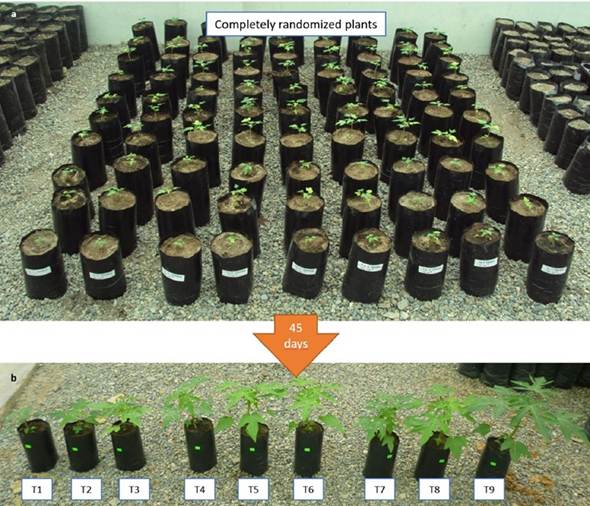
P fertilization is key since this element participates in the energy storage obtained from different metabolic processes, which can influence diverse growth variables ( Tavarini et al., 2018 ). The amount of P that a plant can absorb depends on the quantity and availability of this mineral, which is affected by the soil pH. In this aspect, the mycorrhizae and P fertilization facilitate P absorption in different crops ( Thioub et al., 2019 ). This has been demonstrated by the results of this study ( Figure 1 ), which are similar to the findings of Al-Maghraby et al. (2018 ), who confirmed that P fertilization alongside AMF Glomus spp. managed to increase the dry weight, number of leaves, and other characteristics of onion plants. Moreover, similar results have been observed in other plants, such as Zea mays, Triticum aestivum, Medicago sativa, and Trifolium repens ( Cloutier et al., 2020 ; Liu et al., 2020 ). These results are caused by AMF proliferation inside the roots, increasing the solubilization and absorption rates and improving physiological processes ( Al-Maghraby et al., 2018 ; Liu et al., 2020 ; Nafady & Elgharably, 2018 ; Soretire et al., 2020 ; Varinderpal-Singh et al., 2020 ; Xiao et al., 2020 ).
Figure 1 C. papaya plants treated with R. irregularis and P under greenhouse conditions. A. Plants at 0 days of treatments. B. Plants at 45 days of treatments. Source: Authors’ archives.
According to the statistical analysis, the inoculum quantity and the P concentration significantly affected the growth variables measured in C. papaya plants. However, no significant effect could be observed when measuring the interaction of these factors. Hence, the different P levels did not affect the results of the quantities of R. irregularis inoculum used ( Table 2 ). The results show an increase in the number of leaves, shoot diameter, length, and fresh and dry weight (5 g, 12.33 mm, 6.89 mm, 20.22 cm, 17.81 g, and 2.43 g, respectively) caused by the three levels of R. irregularis inoculation. The 30 and 60 ppm P treatments gave rise to the most significant increases for these variables.
Table 2 Growth variables and variation sources in C. papaya plants Variation Source Shoot Leaf Root Diameter (mm) Length (cm) Fresh weight (g) Dry weight (g) Number of leaves (un) Leaf area index (cm 2 ) Length (cm) Fresh weight (g) Mycorrhi- zation (%) A: Inoculum (g) 0 5.01 c 11.74 c 8.09 c 1.14 c 8.4 c 41.05 b 38.65 a 9.35 c 0.00 c 2 6.14 b 18.02 b 14.33 b 1.93 b 10.27 b 70.33 a 44.02 a 18.11 b 47.37 b 5 6.89 a 20.22 a 17.81 a 2.43 a 12.33 a 83.95 a 39.27 a 22.12 a 65.11 a B: Phosphorous (ppm) 0 5.37 b 13.27 b 9.09 b 1.28 b 9.07 b 50.13 b 41.34 a 12.06 b 39.60 a 30 6.32 a 17.71 a 14.26 a 2.00 a 10.73 a 67.73 a 39.36 a 18.25 a 36.67 a 60 6.35 a 19.01 a 16.89 a 2.22 a 11.20 a 77.45 a 41.24 a 19.25 a 36.22 a ANOVA A **** **** **** **** **** **** ns **** **** B **** **** **** **** **** **** ns **** ns AB ns ns ns ns ns ns ns ns ns CV (%) 9.36 10.95 29 23.63 7.97 23.96 17.5 18.68 13.02 ns: no significance found; ****: p ≤ 0.0001 indicates significant differences. Source: Prepared by the authors.
At the level of roots, R. irregularis inoculation and P concentration did not cause any statistically significant increase in the root length. Nonetheless, the fresh weight was positively affected, reaching a maximum value of 22.12 g, when the plants were treated with 5 g of R. irregularis . Likewise, the 30 and 60 ppm P concentrations caused the highest values of root fresh weight (18.25 and 19.25 g, respectively). Regarding the leaf area, the inoculation with 5 g of R. irregularis induced values of 83.95 and 72.51 cm 2 . Meanwhile, the 0 and 30 ppm P concentrations increased the leaf area values to 67.73 and 77.75 cm 2 , in contrast to the 60 ppm of P, with a value of 68.60 cm 2 . For the mycorrhization percentage, the plants that did not receive AMF inoculum showed 0 % of mycorrhization; this percentage increased statistically (47.37 %) in the plants treated with 2 g of inoculum. Finally, the highest value (65.11 %) of mycorrhization percentage was observed in plants treated with 5 g of R. irregularis inoculum ( Table 2 ). Therefore, the higher concentrations of inoculum induced the higher mycorrhization percentages. The treatment with 5 g of inoculum induced a value of 65.11 %, which contrasted with the other P concentrations and did not statistically affect the mycorrhization percentage ( Table 2 ).
In the C. papaya plants in the study, the inoculation with R. irregularis and P concentration affected the number of leaves ( Table 2 ). Ramos Otiniano et al. (2021 ) obtained the same result in tomato plants by inoculating this species with 0, 1.5, and 3 g of inoculum. Regarding P fertilization, the number of leaves also increased due to the symbiosis established between AMF and C. papaya , which allowed for a rise in this macronutrient absorption at the root level ( Ceballos et al., 2013 ). This nutrient is utilized in the cell division process as well as in cell growth ( Malhotra et al., 2018 ). The same pattern can be observed at the shoot level, where the presence of R. irregularis and the P concentration caused an increase in diameter, length, and fresh and dry weight ( Table 2 ). The increase in these variables was most probably caused by the osmoregulation of nutrients that occurred at the root level during the symbiotic interaction of the crop and R. irregularis (Ramos Otiniano et al., 2021). Likewise, Malhotra et al. (2018) state that the phenotypical variables are more sensitive to P bioavailability due to the role of this element in cell enlargement. As for the fresh and dry weight of the shoot, Cong et al. (2020 ) state that P participates in the photosynthetic process, which guarantees the mass increase in the dry and fresh matter in the shoot.
The leaf area of papaya plants was affected by the quantity of R. irregularis inoculum and P available in the substrate. might indicate that the fungus works along the plant, increasing P acquisition for the cell processes and C exchange ( Malhotra et al., 2018 ), which in turn expands the leaves, augmenting the leaf area. As for the mycorrhization percentage, this variable was only affected by the inoculation with R. irregularis and not by the P levels ( Table 2 ), similar to the results reported by Alaya et al. (2021 a, 2021b). This direct relationship between R. irregularis inoculum quantity and papaya plants could also be explained by a positive effect on the physiological development of the latter ( Fasusi et al., 2021 ). The results at the leaf level, including leaf area and number of leaves, show an overall increase as plants were treated with increasing levels of both P and R. irregularis inoculum ( Table 2 ).
At the root level, root length was unaffected by either factor ( Table 2 ). Similar results were obtained by Alaya et al. (2021 a) in Zea mays and Ramos Otiniano et al. (2021 ) in Solanum lycopersicum . This apparent lack of root growth in length could be related to the space limitations imposed by growing the plants in containers with a limited height. Thus, we must acknowledge that root weight constitutes a better indicator of root development under this condition. Indeed, when evaluating weight, significant differences were observed among plants submitted to the treatments used in this study. P fertilization and inoculation induced higher values with significant differences than the control group. P fertilization also affected root fresh weight, though no difference was observed between the two concentrations used in this research. The increase in root fresh weight is comparable to the findings obtained by Ramos Otiniano et al. (2021) in Solanum lycopersicum , where an increase in root weight was induced by inoculation with R. irregularis . This increase could be influenced by the establishment of the symbiosis between AMF and the plants, which increases the efficiency of the absorption system, inducing an accumulation of nutrients in the roots ( Díaz-Franco et al., 2016 ). Furthermore, White et al. (2018 ) point out that P is an important mineral in establishing root biomass, considering a direct relationship between the acquisition of this element and root weight.
| Variation Source | Shoot | Leaf | Root | ||||||
| Diameter (mm) | Length (cm) | Fresh weight (g) | Dry weight (g) | Number of leaves (un) | Leaf area index (cm 2 ) | Length (cm) | Fresh weight (g) | Mycorrhi- zation (%) | |
| A: Inoculum (g) | |||||||||
| 0 | 5.01 c | 11.74 c | 8.09 c | 1.14 c | 8.4 c | 41.05 b | 38.65 a | 9.35 c | 0.00 c |
| 2 | 6.14 b | 18.02 b | 14.33 b | 1.93 b | 10.27 b | 70.33 a | 44.02 a | 18.11 b | 47.37 b |
| 5 | 6.89 a | 20.22 a | 17.81 a | 2.43 a | 12.33 a | 83.95 a | 39.27 a | 22.12 a | 65.11 a |
| B: Phosphorous (ppm) | |||||||||
| 0 | 5.37 b | 13.27 b | 9.09 b | 1.28 b | 9.07 b | 50.13 b | 41.34 a | 12.06 b | 39.60 a |
| 30 | 6.32 a | 17.71 a | 14.26 a | 2.00 a | 10.73 a | 67.73 a | 39.36 a | 18.25 a | 36.67 a |
| 60 | 6.35 a | 19.01 a | 16.89 a | 2.22 a | 11.20 a | 77.45 a | 41.24 a | 19.25 a | 36.22 a |
| ANOVA | |||||||||
| A | **** | **** | **** | **** | **** | **** | ns | **** | **** |
| B | **** | **** | **** | **** | **** | **** | ns | **** | ns |
| AB | ns | ns | ns | ns | ns | ns | ns | ns | ns |
| CV (%) | 9.36 | 10.95 | 29 | 23.63 | 7.97 | 23.96 | 17.5 | 18.68 | 13.02 |
Shoot Variables
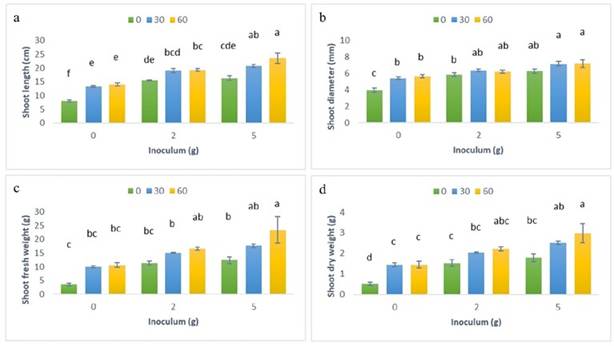
When the plants were analyzed according to the individual treatments, significant differences became evident when the concentrations of P and R. irregularis gradually increased. At the shoot level ( Figure 2 ), the treatments increased the length compared to the control (7.96 cm). In the plants that did not receive R. irregularis inoculum, the 30 ppm and 60 ppm P fertilization increased to 13.26 cm and 14.00 cm, respectively ( Figure 2 a). The shoot length increased in the group of plants treated with 2 g of inoculum. The plants fertilized with 0 and 30 ppm of P, showing no statistical differences with each other, having average heights of 15.54 cm and 19.16 cm, respectively. In this group, the plants fertilized with 60 ppm of P significantly increased (19.36 cm) over the non-P-treated group ( Figure 2 a). Lastly, when 5 g of the R. irregularis inoculum were used, all the plants showed significant increases over those not receiving inoculation. Inside this group, 30 and 60 ppm P fertilization increased plant height to 20.70 and 23.66 cm ( Figure 2 a). Gradual increases in shoot diameter were observed in S. lycopersicum treated with different levels of R. irregularis inoculum ( Ramos Otiniano et al., 2021 ). In C. papaya cv. “Maradol,” treated with different AMF inocula and four concentrations of N, Quiñones-Aguilar et al. (2015 ) reported increased plant height. This increase depended on the AMF used in the study rather than the N concentrations. In fact, the higher N concentrations in papaya “Maradol” reduced both AMF colonization and growth. In comparison, the higher P concentrations in our research did not affect R. irregularis colonization or papaya growth.
Regarding the shoot diameter, the results tended to increase as higher P and inoculum values were used ( Figure 2 b). The control plants (0 ppm of P) showed the minimum diameter (3.96 mm) as compared to the plants treated with 30 and 60 ppm P concentrations, which had statistically higher diameter values (5.42 and 5.64 mm, respectively). In contrast, in the plants treated with 2 g of R. irregularis , no significant differences in shoot diameter were observed among the groups treated with 0, 30, and 60 ppm of P (5.85, 6.36, and 6.21 mm, respectively). The group of plants treated with 5 g of inoculum showed increases in the shoot diameter in the 30 and 60 ppm P fertilization concentration (7.18and 7.19 mm, respectively), which were significant compared to the 0 ppm P fertilized plants (16.30 mm; Figure 2 b). The fresh and dry weights were affected by both factors compared to the control group (3.59 and 0.52 g; Figures 2 c and 2d), with the 30 and 60 ppm P concentrations increasing the fresh weight both in the 0 and 2 g inoculum concentrations to values of 10.02, 10.67, 15.10, and 16.57 g for the fresh weight, and 1.45, 2.04, 1.45, and 2.22 g for the dry weight ( Figures 1 d and 2c). These values were statistically lower than those of plants treated with 5 g of inoculum. In this group, the 30 and 60 ppm P fertilization induced the highest values, with 17.66 and 23.42 g for fresh weight and 2.51 and 2.98 g for dry weight. The results of the groups treated with 5 g Inoculum show no statistically significant differences according to Tukey’s test ( p < 0.05; Figures 2 c and 2d).
Figure 2 Shoot variables in C. papaya plants treated with R. irregularis and different P concentrations under greenhouse conditions. a. Shoot length. b. Shoot diameter. c. Shoot fresh weight. d. Shoot dry weight. Means are represented by vertical bars; different P treatments are colored differently, lines on each bar indicate the standard error, and Tukey’s test ( p < 0.05) groups are shown with different letters above the bars. Source: Prepared by the authors.
Leaf Variables
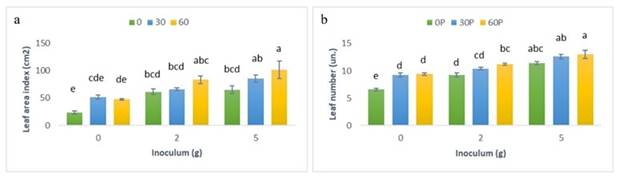
Results for the leaf variables were significantly different according to treatments ( Figure 3 ). The number of leaves increased compared to the control group (6.6 units). In the plants that were not inoculated, the 30 and 60 ppm P treatments increased the number of leaves to 9.2 and 9.4 units ( Figure 3 a). These results were statistically similar to the plants treated with 0 and 30 ppm of P in the groups inoculated with 2 g of R. irregularis (9.2 and 10.4 units, respectively). The 60 ppm P fertilization induced an average statistical increase of 11.2 units in this group. The plants treated with 5 g inoculation showed the highest increase in leaf count to 11.4, 12.6, and 13.0 units, with no statistical differences regarding P fertilization ( Figure 3 a).
Similarly, in S. lycopersicum , the number of leaves increased in plants inoculated with R. irregularis ( Ramos Otiniano et al., 2021 ). However, the leaf count did not differ between the two inoculum levels. This contrasts with our study, in which the treatment with 5 g of R. irregularis inoculum induced a higher number of leaves than with 2 g of inoculum.
The LAI was also affected by P and R. irregularis application ( Figure 3 b). The control group showed the minimum area, with a value of 23.74 cm 2 . The plants that were not inoculated showed statistically similar results, with 23.74, 51.77, and 47.63 cm 2 for the groups with 0, 30, and 60 ppm of P. The groups inoculated with 2 g of R. irregularis were statically similar, with 61.42, 66.02, and 83.54 cm 2 for the increasing P treatments ( Figure 3 b). Finally, in the group of plants fertilized with 5 g of inoculum, the group with the highest leaf area (101.19 cm 2 ) received 60 ppm of P fertilization. However, this value was not significantly different from the 30 ppm treatment (85.42 cm 2 ). The increase in leaf area has been reported in Psidium guajava by Quiñones-Aguilar et al. (2020 ) in plants inoculated with a consortium of AMF. However, in C. papaya inoculated with Rhizophagus intraradices , no difference was observed in the leaf area compared to the non-inoculated plants (Quiñones-Aguilar et al., 2019).
Figure 3 Leaf variables in C. papaya plants treated with R. irregularis and different P concentrations under greenhouse conditions. A. Leaf area index. B. Number of leaves. Means are represented by vertical bars; different P treatments are colored differently, lines on each bar indicate the standard error, and Tukey’s test ( p < 0.05) groups are shown with different letters above the bars. Source: Prepared by the authors.
Root Variables
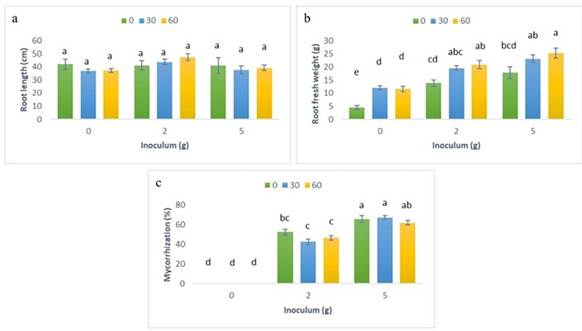
Among the variables measured in the root, the results showed no statistical differences regarding root length in any treatments applied ( Figure 4 a). This contrasts with the results of Alaya et al. (2021 a) in maize, where the plants inoculated had a higher root length than the non-inoculated plants. Nevertheless, significant differences were observed in the fresh weight and mycorrhization results ( Figures 4 b and 4c). Both the P treatments and inoculum addition were related to increases in the root mass compared to the control (4.50 g), and in the plants not inoculated with R. irregularis , the application of P increased the fresh weight to 12.01 and 11.55 g. The groups that were inoculated showed an increase in the root fresh weight ( Figure 4 b), with the 30 and 60 ppm P fertilization having the highest values in the plants inoculated with 2 (19.59 and 20.92 g, respectively) and 5 g (23.15 g and 25.38 g, respectively). However, Tukey’s test ( p < 0.05) did not show statistical differences among these treatments ( Figure 4 b). The increase in root weight in this research contrasts with the findings of Quiñones-Aguilar et al. (2019 ) in C. papaya , where no differences were observed in the plants treated with different AMF inocula. However, different authors have reported that inoculation increases root weight in plants such as S. lycopersicum ( Ramos Otiniano et al., 2021 ) or P. guajava (Quiñones-Aguilar et al., 2020).
Regarding mycorrhization, the application of R. irregularis inoculum induced significant differences among treatments ( Figure 4 c). The mycorrhization percentage was statistically similar in plants treated with 2 g of inoculum and 0, 30, or 60 ppm of P (52.79, 42.67, and 46.67 %). Nonetheless, the plants treated with 5 g of inoculum showed significantly higher levels of mycorrhization (66.00, 67.33, and 62.00 %). In this group of plants, P application did not cause a statistically significant difference among treatments ( Figure 4 c). Though not statistically significant, a slight decrease in mycorrhization percentage (62.00 %) was observed in the plants treated with 60 ppm of P.
Figure 4 Root variables in C. papaya plants treated with R. irregularis and different P concentrations under greenhouse conditions. a. Root length. b. Root fresh weight. c. Mycorrhization percentage. Means are represented by vertical bars; different P treatments are colored differently, lines on each bar indicate the standard error, and Tukey’s test ( p < 0.05) groups are shown with different letters above the bars. Source: Prepared by the authors.
In this research, the P and R. irregularis treatments gradually increased the growth parameters taken into consideration. Even though P is known to negatively impact the establishment of the appropriate symbiosis with AMF, as reported by different studies ( Higo et al., 2020 ), the results herein do not show a reduction in the mycorrhization percentage related to increased P fertilization ( Figures 1 , 2, 3, and 4). This might be related to the P requirements that C. papaya plants have during the first stages of growth ( Vos & Arancon, 2020 ). In these stages, the high P required by the plants might have been provided by a combination of both P fertilization and R. irregularis inoculation, which can further increase the P availability. It is also important to note that there did not seem to be any interaction between the two factors used in this research. However, the shoot and leaf parameters show that the plants inoculated with 5 g of AMF R. irregularis expressed similar results for the 30 and 60 ppm P fertilization. Therefore, in large-scale management, a combination of 5 g inoculum and 30 ppm P fertilization would be optimal to save production costs and obtain the highest growth.
Pearson Correlations
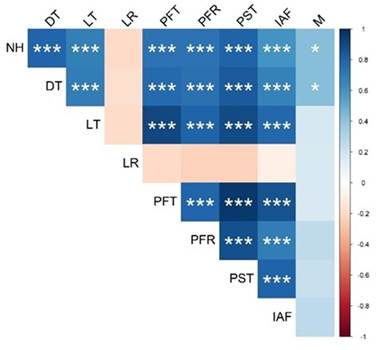
Pearson’s linear correlation test assessed the correlation between the growth variables and two factors ( R. irregularis inoculum and P fertilization; Figure 5 ). According to this test, there were different significance levels based on the 5 % probability t-test. Therefore, the correlation analysis shows a positive and significant relationship between AMF colonization (mycorrhization percentage), number of leaves (0.42), and shoot diameter (0.42). Likewise, this result was observed among different variables, including the number of leaves, shoot diameter (0.79), shoot length (0.68), shoot fresh weight (0.73), root fresh weight (0.73), shoot dry weight (0.80), and LAI (0.59); among shoot diameter, shoot length (0.69), shoot fresh weight (0.77), root fresh weight (0.74), shoot dry weight (0.84) and LAI (0.67); among shoot length, shoot fresh weight (0.90), root fresh weight (0.80), shoot dry weight (0.89) and LAI (0.78); among shoot fresh weight, root fresh weight (0.79), shoot dry weight (0.96) and LAI (0.86); among root fresh weight, shoot dry weight (0.87) and LAI (0.69), and finally, between shoot dry weight and LAI (0.80).
Figure 5 Pearson’s correlation coefficients for the variables evaluated in C. papaya cv. Marel plants treated with R. irregularis and P fertilization. * indicates significance: p < 0.05; ** p < 0.01; *** p < 0.001. DT: shoot diameter, LT: shoot length, LR: root length, PFT: shoot fresh weight, PFR: root fresh weight, PST: shoot dry weight, IAF: leaf area index, M: mycorrhization percentage, n.s.: no significant correlation. Source: Prepared by the authors.
The positive correlation results among AMF colonization, number of leaves, and shoot diameter ( Figure 5 ) agree with the results of Quiñones-Aguilar et al. (2020 ). They found that native AMF inoculation in P. guajava significantly increased plant growth, demonstrated by a higher leaf count and shoot diameter than a commercial AMF product. Likewise, Cristóbal-Alejo et al. (2022 ) research in Annona muricata reports that an AMF-based consortium including ( Glomus ambisporum, G. pustulatum, Claroideoglomus claroideum, Funneliformis geosporum, and Ambispora gerdemannii ) increased shoot height, diameter and number of leaves. On the other hand, the strong positive correlation reported by Schober et al. (2018 ), among other growth parameters, might be related to the positive effects in the absorption observed in different crops ( Aranguren et al., 2020 ). These positive correlations have also been noted in different studies, including Chenchouni et al. (2020 ) research, in which positive, moderate, and strong correlations among morphometric variables and inoculation of commercial and native AMF were found in Olea europaea plants. Among fruit plants, different investigations show similar results obtained in Ananas comosus , Coffea arabiga , and S. lycopersicum plants, increasing both the vegetative growth and fruit yield ( Higo et al., 2020 ; Moreira et al., 2019 ; Trejo et al., 2021 ). However, the amount of P fertilization utilized has to be carefully calculated to avoid colonization inhibition due to AMF being sensitive to high P levels ( Saheed & Darwesh, 2021 ; Trejo et al., 2021; Yazici et al., 2021 ).
This research details the effects of P fertilization and AMF inoculation on C. papaya during the acclimatization phase under greenhouse conditions. However, there are several limitations to this study. Firstly, this study was performed under greenhouse conditions, where environmental factors such as temperature and humidity are controlled, which does not happen in agroecosystems. Secondly, in this study, only one AMF species has been evaluated, whereas, in nature, several species could potentially interact with R. irregularis and affect the development of mycorrhization. Finally, the substrate was sterile, and different soil types can significantly affect the development of fungi. To address these limitations, further research needs to be done under field conditions to examine how the interaction between plants, AMFs, and P fertilization could be affected by environmental factors such as humidity, temperature, soil type, and the presence of different microbiota species to contribute to the development of sustainable papaya cultivation systems.
Conclusion
Rhizophagus irregularis inoculation and P fertilization significantly increased Carica papaya L. growth under greenhouse conditions after the acclimatization stage for 45 days of treatment. The increase in growth was higher in the shoot and leaf variables and in the root fresh weight when plants were treated with 5 g R. irregularis inoculum and 30 or 60 ppm of P. These findings demonstrate that the P levels used in this research did not negatively impact mycorrhization percentage, and this absence of negative interaction was beneficial for C. papaya growth under greenhouse conditions.
Referencias
- Alaya, B. S. L., Hidalgo Rodríguez, J. E. M., Otiniano, C. C. R., Vera Vega, M. Á., Huamán, J. J. P., Lujan Rojas, J. M., & Chaman Medina, M. E. (2021a). Efecto de diferentes cantidades de inóculos
Rhizophagus irregularis sobre el porcentaje de micorrización y crecimiento enZea mays L. var. canteño (Poaceae) en condiciones de invernadero.Arnaldoa ,28 (3), 651-674. http://www.scielo.org.pe/scielo.php?script=sci_arttext&pid=S2413-32992021000300651 - Alaya, B. S. L., Hidalgo Rodríguez, J. E. M., Ramos Otiniano, C. C., Vera Vega, M. Á., Huamán, J. J. P., Lujan Rojas, J. M., & Chaman Medina, M. E. (2021b). Contenido de prolina en
Zea mays L. var. canteño (Poaceae) tratado conRhizophagus irregularis y NaCl.Arnaldoa ,28 (3), 693-716. http://www.scielo.org.pe/scielo.php?script=sci_arttext&pid=S2413-32992021000300693 - Al-Maghraby, A., Bardisi, A., & Mohsen, A. (2018). Effect of Phosphorus Fertilization and Inoculation with Mycorrhizae on Plant Dry Weight and Chemical Composition of Two Onion Cultivars.
Zagazig Journal of Agricultural Research ,45 (6), 1885-1899. https://doi.org/10.21608/zjar.2018.47727 - Aranguren, Y., Castellanos, L., & Escalante, J. (2020). Arbuscular mycorrhizal fungi (AMF) in Colombian fruit trees and their comparability with international research.
Ciencia y Tecnología Agropecuaria , 5(1), 27-37. https://ojs.unipamplona.edu.co/index.php/rcyta/article/view/794 - Ceballos, I., Ruiz, M., Fernández, C., Peña, R., Rodríguez, A., & Sanders, I. R. (2013). The in vitro mass-produced model mycorrhizal fungus,
Rhizophagus irregularis , significantly increases yields of the globally important food security crop cassava.PLoS one , 8(8), e70633. https://doi.org/10.1371/journal.pone.0070633 - Chenchouni, H., Mekahlia, M. N., & Beddiar, A. (2020). Effect of inoculation with native and commercial arbuscular mycorrhizal fungi on growth and mycorrhizal colonization of olive (
Olea europaea L.).Scientia Horticulturae ,261 (October), 108969. https://doi.org/10.1016/j.scienta.2019.108969 - Cloutier, M. L., Murrell, E., & Barbercheck, M. (2020). Fungal community shifts in soils with varied cover crop treatments and edaphic properties.
Scientific Reports ,10 , 6198. https://doi.org/10.1038/s41598-020-63173-7 - Cong, W. F., Suriyagoda, L. D., & Lambers, H. (2020). Tightening the phosphorus cycle through phosphorus-efficient crop genotypes.
Trends in Plant Science ,25 (10), 967-975. https://doi.org/10.1016/j.tplants.2020.04.013 - Cristóbal-Alejo, J., Lima-Burgos, A., & Tun-Suárez, J. M. (2022). Hongos micorrízicos arbusculares aceleran el tiempo de crecimiento de portainjertos de guanábana (
Annona muricata L.).Ecosistemas y Recursos Agropecuarios . 9(1), 1-9. https://era.ujat.mx/index.php/rera/article/view/3226 - Díaz-Franco, A., Ortiz-Cháirez, F. E, & Espinosa-Ramírez, M. (2016). Mycorrhizal symbiosis and growth of sorghum plants irrigated with saline water.
Revista Chapingo Serie Zonas Áridas ,15 (1), 55-64. https://doi.org/10.5154/r.rchsza.2016.01.001 - Fasusi, O. A., Amoo, A. E., & Babalola, O. O. (2021). Propagation and characterization of viable arbuscular mycorrhizal fungal spores within maize plant (
Zea mays L.).Journal of the Science of Food and Agriculture ,101 (1), 5834-5841. https://doi.org/10.1002/jsfa.11235 - Fitch, M. M., Ancheta, M. J., Huynh, L. C., He, X., Ortega, M. A., Fields, H. K., & Lopez, J. J. (2022). Micropropagation of Hermaphrodite Papayas: Increased Root Induction and Plant Survival during Acclimatization.
HortScience ,57 (5), 629-633. https://doi.org/10.21273/HORTSCI16498-22 - Fuentes, G., & Santamaría, J. M. (2014). Papaya (
Carica papaya L.): Origin, Domestication, and Production. In R. Ming & P. Moore (Eds),Genetics and Genomics of Papaya .Plant Genetics and Genomics: Crops and Models (Vol. 10, pp. 3-15). https://doi.org/10.1007/978-1-4614-8087-7_1 - Gautam, G. K., Rona, Z. A., Kumar, R., Kumar, M., & Kumar, G. (2022). A review of Carica papaya’s geographical origins and pharmacological activities.
IP International Journal of Comprehensive and Advanced Pharmacology , 7(2), 81-86. https://doi.org/10.18231/j.ijcaap.2022.015 - González, J. J. R., Granero, M. L., & Encina, C. L. (2021). In Vitro Long-Term Cultures of Papaya (
Carica papaya L.).Research Square [preprint]. https://doi.org/10.21203/rs.3.rs-262638/v1 - Hidalgo Rodríguez, J. E., Ramos Otiniano, C. M., & Chaman Medina, M. E. (2014). Efecto de diferentes concentraciones NPK y simbiosis con
Glomus intraradices , sobre el contenido de proteínas solubles totales dePlukenetia volubilis L.Arnaldoa ,21 (2), 329-342. https://doi.org/10.22497/165 - Hidalgo Rodríguez, J. E. M., Ramos Otiniano, C. C., Pedro Huamán, J. J., Luis Alaya, B. S., & Chaman Medina, M. E. (2021). Coinoculación de
Rhizophagus irregularis yTrichoderma viride enCarica papaya (Caricaceae) “papaya” en condiciones de invernadero.Arnaldoa ,28 (2), 349-364. https://doi.org/10.22497/1597 - Higo, M., Azuma, M., Kamiyoshihara, Y., Kanda, A., Tatewaki, Y., & Isobe, K. (2020). Impact of Phosphorus Fertilization on Tomato Growth and Arbuscular Mycorrhizal Fungal Communities.
Microorganisms , 8(2), 178. https://doi.org/10.3390/microorganisms8020178 - Liu, M., Zhao, Z., Chen, L., Wang, L., Ji, L., & Xiao, Y. (2020). Influences of arbuscular mycorrhizae, phosphorus fertiliser and biochar on alfalfa growth, nutrient status and cadmium uptake.
Ecotoxicology and Environmental Safety ,196 , 110537. https://doi.org/10.1016/j.ecoenv.2020.110537 - Malhotra, H., Sharma, S., & Pandey, R. (2018). Phosphorus Nutrition: Plant Growth in Response to Deficiency and Excess. In M. Hasanuzzaman, M. Fujita, H. Oku, K. Nahar, & B. Hawrylak-Nowak (Eds.),
Plant Nutrients and Abiotic Stress Tolerance (pp. 171-190). Springer. https://doi.org/10.1007/978-981-10-9044-8_7 - Mitra, S., Fuentes, G., Chan, A., Girón, A., Estrella, H., Espadas, F., & Santamaria, J. M. (2020). Origin, History, Composition and Processing. In S. Mitra,
The Papaya: Botany, Production and Uses (pp. 1-11). CABI International. https://doi.org/10.1079/9781789241907.0001 - Moreira, S. D., França, A. C., Grazziotti, P. H., Leal, F. D. S., & Silva, E. D. B. (2019). Arbuscular mycorrhizal fungi and phosphorus doses on coffee growth under a non-sterile soil.
Revista Caatinga ,32 (1), 72-80. https://doi.org/10.1590/1983-21252019v32n108rc - Moreno-Hernández, M. R., Spinoso-Castillo, J. L., Sánchez-Segura, L., Sánchez-Páez, R., & Bello-Bello, J. J. (2022). Arbuscular Mycorrhizal Fungi: Inoculum Dose Affects Plant Development and Performance of Sugarcane (
Saccharum spp .) Plantlets During Acclimatization Stage.Journal of Soil Science and Plant Nutrition ,22 , 4847-4856. https://doi.org/10.1007/s42729-022-00964-z - Nafady, N. A., & Elgharably, A. (2018). Mycorrhizal symbiosis and phosphorus fertilization effects on
Zea mays growth and heavy metals uptake.International Journal of Phytoremediation ,20 (9), 869-875. https://doi.org/10.1080/15226514.2018.1438358 - Ordoñez Castañeda, Y. M., Ceballos Rojas, I. C., Rodriguez Villate, A., & Sanders, I. (2021). Efecto de la inoculación
Rhizophagus irregularis y de la fertilización fosfatada sobre la comunidad local de hongos formadores de micorrizas arbusculares.Biotecnología en el Sector Agropecuario y Agroindustrial ,19 (2), 184-200. https://doi.org/10.18684/bsaa.v19.n2.2021.1850 - Phillips, J. M., & Hayman, D. S. (1970). Improved procedures for clearing roots and staining parasitic and vesicular-arbuscular mycorrhizal fungi for rapid assessment of infection.
Transactions of the British Mycological Society ,55 (1), 157-160. https://doi.org/10.1016/S0007-1536(70)80110-3 - Posada-Perez, L., Gómez-Kosky, R., Padron, Y., Galvez, D., & Daniels, D. (2022). Somatic Embryogenesis in Papaya (
Carica papaya L.). In M. A. Ramírez-Mosqueda (Ed.),Methods in Molecular Biology (pp. 143-157). Springer US. https://doi.org/10.1007/978-1-0716-2485-2_12 - Quiñones-Aguilar, E. E., Rincón-Enríquez, G., & López-Pérez, L. (2019). Hongos micorrizícos arbusculares y vermicomposta en el crecimiento de papaya (
Carica papaya L) en invernadero.AgroProductividad ,12 (1), 47-52. https://doi.org/10.32854/agrop.v0i0.1343 - Quiñones-Aguilar, E. E., Rincón-Enríquez, G., & López-Pérez, L. (2020). Hongos micorrízicos nativos como promotores de crecimiento en plantas de guayaba (
Psidium guajava L.).Terra Latinoamericana ,38 (3), 541-554. https://doi.org/10.28940/terra.v38i3.646 - Quiñones-Aguilar, E. E., Rincón-Enríquez, G., Fernández-Pérez, A., & López-Pérez, L. (2017). Influencia de hongos micorrízicos arbusculares en el crecimiento de plántulas de guayaba (
Psidium guajava L) en invernadero.Biotecnología y Sustentabilidad , 2(1), 1-7. - Quiñones-Aguilar, E. E, Rincón-Enríquez, G., Hernández-Cuevas, L. V., & López-Pérez, L. (2015). Influence of arbuscular mycorrhizal fungi and nitrogen concentrations on
Carica papaya plant growth.International Journal of Agriculture & Biology ,17 (1) 119‒126. - Ramos Otiniano, C. C., Hidalgo Rodríguez, J. E. M, Vera Vega, M. A., Pedro Huaman, J. J., Rodríguez Seminario, C. E., & Chaman Medina, M. E. (2021). Efecto del NaCl y micorrizas (
Rhizophagus irregularis ) en el crecimiento de “tomate”Solanum lycopersicum L. (Solanaceae).Arnaldoa ,28 (3), 675-692. http://www.scielo.org.pe/scielo.php?script=sci_arttext&pid=S2413-32992021000300675 - Saheed, S. A., & Darwesh, D. A. (2021). Combination Effect of Mycorrhizal Inoculation and Phosphorus Fertilizer on Yield Components of two Wheat Species.
Zanco Journal of Pure and Applied Sciences ,33 (s1), 93-102. https://www.iasj.net/iasj/article/203573 - Schober, P., Boer, C., & Schwarte, L. A. (2018). Correlation coefficients: Appropriate use and interpretation.
Anesthesia and Analgesia ,126 (5), 1763-1768. https://doi.org/10.1213/ANE.0000000000002864 - Soretire, A. A., Adeyemi, N. O., Atayese, M. O., Sakariyawo, O. S., & Adewunmi, A. (2020). Nodulation and biological nitrogen fixation in soybean (
Glycine max L.) as influenced by phosphorus fertilization and arbuscular mycorrhizal inoculation.Acta Universitatis Sapientiae, Agriculture and Environment ,12 (1), 22-44. https://doi.org/10.2478/ausae-2020-0003 - Tavarini, S., Passera, B., Martini, A., Avio, L., Sbrana, C., Giovannetti, M., & Angelini, L. G. (2018). Plant growth, steviol glycosides and nutrient uptake as affected by arbuscular mycorrhizal fungi and phosphorous fertilization in
Stevia rebaudiana Bert.Industrial Crops and Products ,111 , 899-907. https://doi.org/10.1016/j.indcrop.2017.10.055 - Thioub, M., Ewusi-Mensah, N., Sarkodie-Addo, J., & Adjei-Gyapong, T. (2019). Arbuscular mycorrhizal fungi inoculation enhances phosphorus use efficiency and soybean productivity on a Haplic Acrisol.
Soil and Tillage Research ,192 , 174-186. https://doi.org/10.1016/j.still.2019.05.001 - Toro, M., & Andrade, G. (2021). Arbuscular Mycorrhizae: Beneficial Microorganisms for Sustainable Agriculture. In W. Leal Filho, A. M. Azul, L. Brandli, A. Lange Salvia, & T. Wall (Eds),
Life on Land. Encyclopedia of the UN Sustainable Development Goals (pp. 57-70). Springer. https://doi.org/10.1007/978-3-319-95981-8_122 - Trejo, D., Sangabriel-Conde, W., Gavito-Pardo, M. E., & Banuelos, J. (2021). Mycorrhizal inoculation and chemical fertilizer interactions in pineapple under field conditions.
MDPI Agriculture ,11 (10), 1-8. https://doi.org/10.3390/agriculture11100934 - Varinderpal-Singh, Kunal, Sharma, S., Gosal, S. K., Choudhary, R., Singh, R., & Adholeya, A. (2020). Optical Sensing and Arbuscular Mycorrhizal Fungi for Improving Fertilizer Nitrogen and Phosphorus Use Efficiencies in Maize.
Journal of Soil Science and Plant Nutrition ,20 (4), 2087-2098. https://doi.org/10.1007/s42729-020-00277-z - Vos, C., & Arancon, N. (2020). Soil and plant nutrient management and fruit production of papaya (
Carica papaya ) in Keaau, Hawaii.Journal of Plant Nutrition ,43 (3), 384-395. https://doi.org/10.1080/01904167.2019.1677712 - White, P. J., Bradshaw, J. E., Brown, L. K., Dale, M. F. B., Dupuy, L. X., George, T. S., & Wright, G. (2018). Juvenile root vigour improves phosphorus use efficiency of potato.
Plant and Soil ,432 (1), 45-63. https://doi.org/10.1007/s11104-018-3776-5 - Xiao, Y., Liu, M., Chen, L., Ji, L., Zhao, Z., Wang, L., Wei, L., & Zhang, Y. (2020). Growth and elemental uptake of
Trifolium repens in response to biochar addition, arbuscular mycorrhizal fungi and phosphorus fertilizer applications in low-Cd-polluted soils.Environmental Pollution ,260 , 113761. https://doi.org/10.1016/j.envpol.2019.113761 - Yazici, M. A., Asif, M., Tutus, Y., Ortas, I., Ozturk, L., Lambers, H., & Cakmak, I. (2021). Reduced root mycorrhizal colonization as affected by phosphorus fertilization is responsible for high cadmium accumulation in wheat.
Plant and Soil ,468 (1-2), 19-35. https://doi.org/10.1007/s11104-021-05041-5